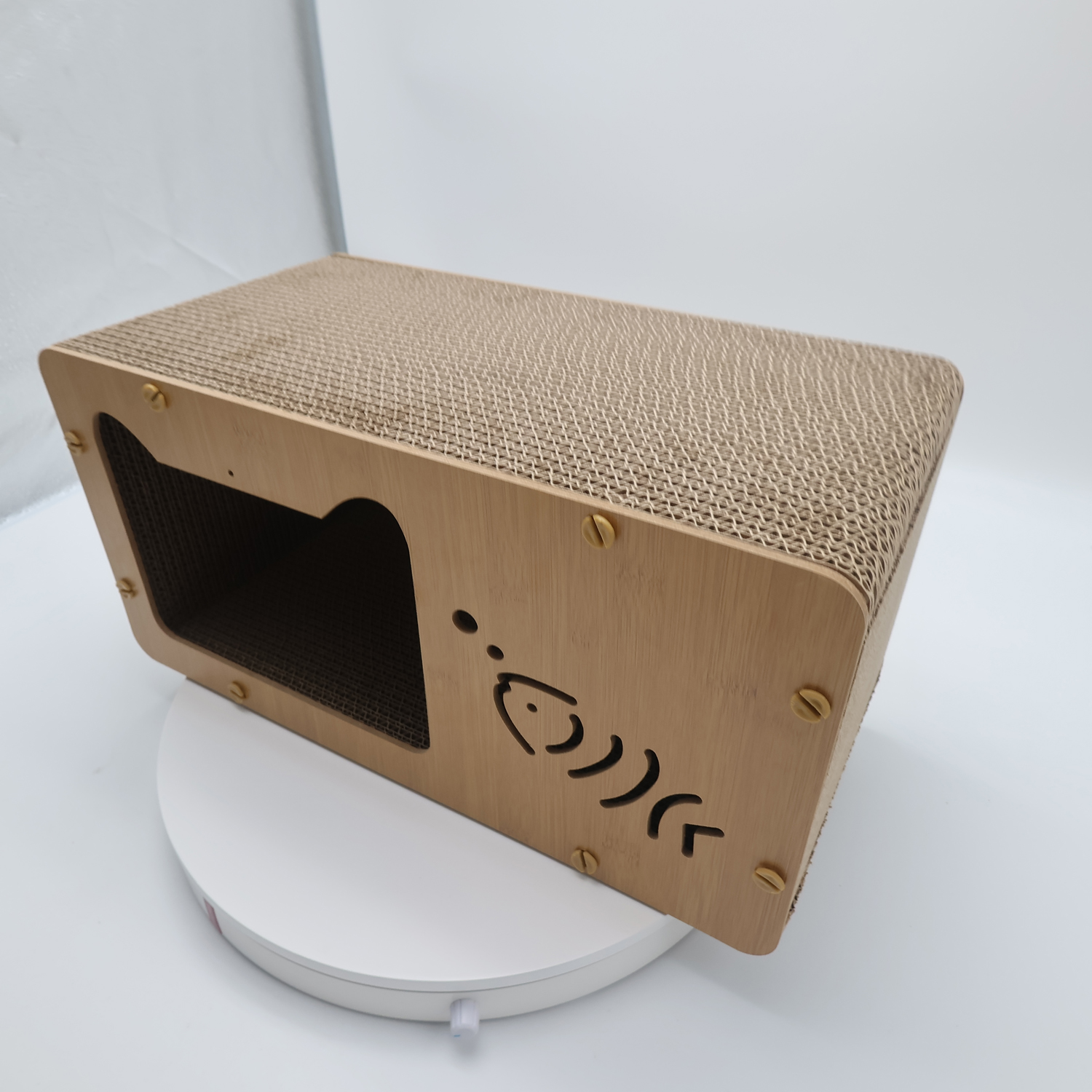
Every pet parent eventually discovers a universal feline truth. Cats consistently prefer the simple cardboard delivery box over the expensive plush bed inside it. This quirk charms us. However, standard flat scratching pads rarely solve your long-term furniture issues. They quickly create a massive shredding mess. They slide aggressively across your living room floor during use. Most importantly, flat designs fail to provide the enclosed security cats desperately crave. You might try DIY solutions out of sheer frustration. Yet, homemade options often lack structural durability. They frequently rely on unsafe adhesives.
We clearly need a better approach to indoor feline enrichment. A structured cardboard cat house with scratching pad perfectly bridges feline behavioral needs. It provides deep security. It allows essential scent marking. It fully satisfies aggressive scratching urges. Simultaneously, it meets strict owner and retailer demands. You get reliable durability, pleasing aesthetic appeal, and significant mess reduction. Let us explore what makes a high-quality unit truly worth the investment. We will bridge the crucial gap between feline psychology and structural longevity.
Key Takeaways
Behavioral Alignment: Enclosed cardboard houses fulfill three core feline instincts: territorial security, thermoregulation, and olfactory/visual marking.
Material Matters: A thickened corrugated scratching surface is the primary differentiator between a messy, short-lived pad and a durable, furniture-grade scratcher.
Commercial Viability: Flat-pack shipping, high replacement cycles, and dual-purpose design make these units a staple for both individual owners and pet stores.
Smart Purchasing: Evaluating flute density, adhesive safety, and weight capacity prevents premature breakdown and ensures a safer environment for pets.
The Science of Feline Behavior: Why an Enclosed Cat Scratching House Works
Feline behavior experts often emphasize environmental enrichment. Cats need specific structural elements to feel completely secure indoors. A well-designed cat scratching house delivers multiple psychological benefits. It addresses core survival instincts passed down from their wild ancestors.
Acoustic & Tactile Feedback
When claws meet densely packed corrugated layers, cats receive immediate tactile resistance. This resistance closely mimics natural tree bark. It conditions their claws perfectly by stripping away dead husks. Furthermore, the sound provides immense acoustic satisfaction. The ripping noise stimulates a cat neurologically. It reinforces their natural hunting and marking drives. You will notice your pet returning to the same satisfying spot repeatedly.
Thermoregulation & Confined Spaces
Cats naturally run at a higher body temperature than humans. They constantly seek out warm areas. Cardboard acts as a fantastic thermal insulator. An enclosed roof traps body heat efficiently. This creates an ideal, self-warming micro-climate. Cats instinctually seek out these confined spaces to rest safely. The walls protect their vulnerable flanks while they sleep.
Territorial Marking (Beyond the Claws)
Scratching is never just about sharpening claws. It serves as a complex territorial behavior. Cats possess unique interdigital scent glands in their paw pads. When they scratch vigorously, they deposit distinct pheromones into the material. An enclosed space concentrates this personal scent quickly. The entire structure becomes a secure, highly personalized sanctuary.
Best Practice: Place the new house near your pet's preferred resting spot to encourage immediate investigation.
Common Mistake: Hiding the house in a dark, low-traffic basement. Cats scratch to mark territory in socially significant areas.
Evaluating Build Quality: The Role of a Thickened Corrugated Scratching Surface
Not all cardboard serves the same purpose. Material engineering dictates the overall lifespan of pet products. You must understand internal structural differences before making a purchase.
Density vs. Degradation
Standard single-wall cardboard shreds almost instantly. It leaves a massive, frustrating floor mess. Your vacuum cleaner works overtime. Multi-layer corrugated boards solve this common problem entirely. They resist tearing under heavy claw pressure. Manufacturers press these layers together tightly. This high-density construction limits debris scatter. It transforms a flimsy box into a robust piece of pet furniture.
The "Flute" Architecture
Fluting refers to the wavy inner paper layer. Tighter fluting supports heavier cats perfectly. It stops the roof from collapsing inward. Large breeds like Maine Coons or Ragdolls absolutely need this structural integrity. A thickened corrugated scratching surface relies on optimal flute density to survive daily abuse.
Cardboard Flute Architecture Comparison
Flute Type
Thickness Profile
Weight Capacity
Best Use Case
A-Flute
Thickest (approx. 5mm)
Very High
Heavy-duty structural walls
B-Flute
Medium-Thick (approx. 3mm)
High
Base scratching pads
C-Flute
Standard (approx. 4mm)
Moderate
General shipping boxes
E-Flute
Thin (approx. 1.5mm)
Low
Decorative retail packaging
Adhesive Safety & Sustainability
We must strictly prioritize non-toxic glues. Cats occasionally bite and ingest small cardboard pieces during aggressive play. Cornstarch-based adhesives protect feline digestive tracts. Industrial chemical glues pose severe health risks. Additionally, complete recyclability matters immensely. Once the unit finally breaks down, you can toss it straight into your household recycling bin. This ensures a sustainable product lifecycle.
DIY vs. Commercial Builds: Assessing the Real Cost
Many owners watch online tutorials. They attempt to craft custom cat boxes from old delivery packages. We must assess the true cost of these weekend projects honestly.
The DIY Reality Check
Building a homemade cat box sounds incredibly fun. Yet, you inevitably face hidden costs. It takes considerable time to measure and cut thick materials. Structural integrity usually suffers without professional tools. The roof might cave in after one week. Worse, you risk exposing pets to toxic packing tape or industrial shipping glue left over on the original boxes.
You need absolutely zero metal hardware for assembly.
The edges remain perfectly smooth, preventing paper cuts.
The modular design locks load-bearing walls together securely.
Many units include reversible interior floor pads.
This simple reversible feature effectively doubles the product lifespan.
The Verdict
DIY projects offer temporary weekend entertainment. However, commercial units provide predictable longevity. They ensure rigorous safety standards. Homemade alternatives rarely match this advanced level of engineering. Spending a few extra dollars saves you hours of frustrating repair work later.
Sourcing and Scalability: The Cardboard Cat House for Pet Stores
Retail buyers love this specific product category. The physical attributes make it a dream for warehouse logistics and floor merchandising.
Retailer Economics
This inventory category drives remarkably high profit margins. It features very low dimensional shipping weight. Flat-pack storage maximizes your valuable warehouse efficiency. You can fit dozens of units on a single pallet. Furthermore, owners must replace worn floor pads periodically. This creates a highly predictable, recurring revenue model. Customers return to your shop repeatedly for refills.
Procuring Cat Scratching Pads Wholesale
When sourcing cat scratching pads wholesale, procurement managers must look for specific supplier traits. Do not just buy the cheapest option available.
Consistent Board Density: Squeeze the samples. They should feel rock solid.
Customizable Branding: Request custom exterior prints. This helps you stand out in a crowded market.
Drop-Test Passing Packaging: The retail box must survive rough transit. Damaged corners ruin the structural assembly process.
Merchandising Potential
Smart boutique owners position these units strategically. A beautifully designed cardboard cat house for pet stores works as a premium eco-furniture piece. Display a fully assembled floor model near the checkout counter. Place a toy mouse inside it. This visual setup transforms a boring necessity into an irresistible impulse buy. It elevates your average order value significantly.
The Buyer’s Shortlist: How to Choose the Right Model
Consumers face endless options online. You need a clear, objective framework to evaluate competing products effectively.
Size & Entryway Dimensions
Always match the house size to the specific breed. A petite 8-pound cat requires vastly different doorway clearance than a muscular 15-pound feline. Measure your pet from nose to tail base before buying. Ensure the interior floor space allows them to turn around completely.
Reversible Core Integrations
Always check the bottom scratching pad setup. Can you remove it easily? Can you flip it over? Premium designs let you replace the pad independently of the exterior walls. You save significant money long-term by only replacing the heavily shredded components.
Weight Load Testing
Demand verifiable weight capacities. Cats will inevitably jump on top. They love sitting on the highest vantage point. They will sleep on the roof daily. The structure must hold their full weight without bowing. Look for internal support columns or reinforced roof panels.
Ventilation
Never buy a completely sealed box. Look for thoughtful secondary cutouts. Small windows and rear doors prevent stagnant air buildup. They also offer incredibly fun, interactive play angles. You can dangle feather wands through the windows. This encourages active hunting behavior inside the safe zone.
Conclusion
We must stop viewing these units as mere novelty items. They represent a deeply behaviorally sound investment. They actively save your expensive human furniture from destruction. They fully satisfy innate feline instincts. A well-crafted enclosed structure offers warmth, security, and the perfect claw-conditioning surface.
When shopping, prioritize dense corrugated materials strictly. Insist on non-toxic, plant-based construction methods. Ignore cute but physically flimsy designs. A flimsy house frustrates your pet and wastes your money. Durability always trumps flashy exterior graphics.
Take action today to improve your pet's environment. Check the exact dimensions of your shortlisted models. If you buy for retail, request wholesale material samples immediately. Always test the flute density manually before committing to a large bulk order. Your customers, and their cats, will thank you.
FAQ
Q: How long does a cardboard cat house typically last?
A: Lifespan depends entirely on material quality and your pet's energy levels. For a single cat, the interior scratching pad usually lasts 3 to 6 months. The exterior house structure often survives much longer. Reversible base pads can effectively double this timeframe. Replace the internal unit when the corrugated layers flatten completely.
Q: Is the glue used in commercial cardboard scratchers safe for cats?
A: Reputable commercial scratchers prioritize safety above all else. They avoid harsh industrial chemical glues entirely. Instead, they use pet-safe, plant-based adhesives like natural cornstarch glue. This ensures cats remain perfectly safe even if they accidentally swallow small cardboard fragments while playing aggressively.
Q: Can you replace just the scratching pad without buying a whole new house?
A: Yes. Many premium models feature a smart modular design. They offer interchangeable base pads. Once your cat shreds the top layer, you can flip it over. When both sides finally wear out, you simply insert a fresh refill pad directly into the existing outer house base.
Q: How do I get my cat to start using the new cardboard house?
A: Strategic placement is critical for early adoption. Put the house near their favorite sunny sleeping areas or next to the couch they already scratch. You can also sprinkle a small pinch of organic catnip inside. This controlled use of catnip builds initial excitement and strongly encourages curious exploration.
We are a manufacturer specializing in eco-friendly packaging , pet supplies and home solutions, with 20 years of R&D and production experience in paper products and pet supplies. Now we have decided to go global, making our products accessible to everyone in every corner of the world.